
The education industry is in the midst of a major digital transformation. Publishers are no longer just producing textbooks and printed learning materials; they are expected to deliver engaging digital learning experiences that meet the needs of modern classrooms. With more and more schools moving online and blending learning, publishers need a platform to build, manage and distribute interactive courses efficiently.
One of the best solutions is to implement a K-12 Education Learning Management System (LMS) that supports SCORM compliant courseware. Such a platform allows publishers to convert their traditional educational materials into interactive digital courses, which can be consumed on any device at any time.
In this blog, we’ll discuss what publishers should be looking for in a course creation platform, and how a K-12 LMS with SCORM compatibility can turn educational content into engaging learning experiences.
Why Publishers need Engaging course creation platform solutions
Educational publishers have transcended textbook publishing. Schools and educators today expect publishers to offer full digital learning solutions that include:
Interactive online lessons
Learning Resources Multimedia
Digital Assessments and quizzes
Tracking student progress
Digital certificates
Mobile learning experiences
It can be a challenge to manage all of these parts by hand. A dedicated LMS offers a centralized learning environment for educators and students . It also streamlines content delivery .
Key Features Publishers Need in AI-Powered Courseware Authoring
When selecting the right platform, look for features that will help you with content creation and engaging learners.
1. Simple Course Creation
A modern LMS should allow publishers to assemble structured courses that include videos, PDFs, presentations, images, assignments, and interactive activities without requiring high technical skill.
2. SCORM compliant courseware
SCORM (Sharable Content Object Reference Model) is an industry standard for e-learning content. When an LMS supports SCORM, it allows publishers to upload, launch and track standardized learning content across multiple schools.
The benefits of SCORM compliance are:
Learning content that can be reused.
Cross Platform Support
Standardize tracking of learner performance
Update the content easily
Better interoperability
Lower development costs
This means that publishers can create content once and push it out to multiple schools and LMS environments without a lot of changes.”
3. Help for K-12 Learning
A K-12 education platform should address the unique needs of schools, teachers, students and administrators.
Key features of K-12 include:
Course organization by grade level
Subject curriculum management
Managing student enrollment
Teachers Dashboards
Tools for parent communication
Assignments and homework
Web Testing
Progress reports (
They foster a collaborative learning environment that supports both classroom and remote education.
4. Interactive Learning Engagement
Students are more engaged when learning doesn’t just mean reading from a static text. Interactive learning tools may include:
Video Video
Animations
Interactive testing
Discussion boards
Gamification: •
Virtual classrooms go live
Group Assignments
These features enhance knowledge retention and promote active participation.
5. Mobile Learning
Students are increasingly using smartphones and tablets for learning content. With a responsive LMS, the learning continues on any device without sacrificing user experience.
6. Analytics for learning
Dashboards also provide information to publishers and educators in the areas of:
Student involvement
Completion of course
Quiz Results
Engagement
Progress in learning
Effectiveness of the content
These analytics inform data-driven decisions that lead to improved educational outcomes.
How a K-12 Education LMS Helps Publishers
A dedicated K-12 LMS can provide publishers with much more than just course hosting. It becomes a complete digital learning platform that connects content creators, schools, teachers, students and parents.
Turn Textbooks Into Online Courses
Publishers can turn printed educational content into interactive online lessons with multimedia, assessments, and downloadable content.
Provide SCORM Compliant Learning Content
SCORM compliant publishers can deliver standardized digital courseware that fits into SCORM compliant learning environments without a hitch. That makes deploying content faster, more reliable and easier to maintain.
Curriculum Based Learning Support
Courses can be arranged by
- grades
- Topics
- Academic language
- Learning results
- National or regional curriculum standards
This way the educational content is in tune with the school’s requirements.
Enhance Student Engagement
Interactive courseware – This form of courseware involves learners with multimedia lessons, quizzes, assignments, and collaborative activities to help make the learning experience more interesting and effective.
Streamline Content Management
Publishers can update courses centrally so that schools always have the latest educational content without the need for printed revisions.
Increase Market Reach
A cloud based LMS enables publishers to deliver educational content to schools, coaching institutes, tutoring centers and learners in different regions from one platform.
Advantages of SCORM-Compliant Courseware for Publishers
The value of SCORM compliance comes in the long run, in making digital content flexible and reusable.
Some of the key benefits include:
- Create content once, and deploy it across multiple LMSs.
- Track learner progress regularly.
- Make it easier to distribute.
- It reduces compatibility issues.
- Enhance the lifespan of digital learning resources.
- Enable interactive learning modules.
- Enhanced reporting and performance analytics.
For publishers with large libraries of educational resources, SCORM makes the management of digital content much easier.
Comparison of Top Course Creation Platforms
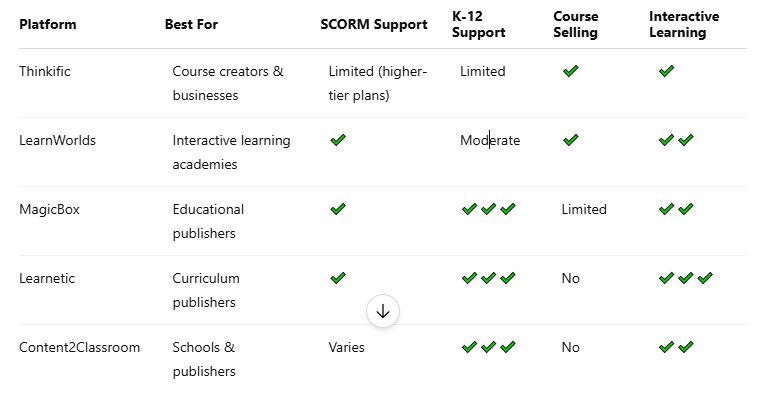
What Platform is Best for Educational Publishers?
The perfect platform depends on your publishing goals and requiredments:
- Thinkific is perfect for publishers who want to create and monetize online courses with eCommerce built-in.
- LearnWorlds offers a great solution for publishers looking for SCORM compatible content delivery and interactive learning experiences.
- MagicBox is built for K-12 learning ecosystems and educational publishers with large digital content libraries.
- Learnetic specializes in creating digital learning content that is aligned with the curriculum for schools and educational institutions.
- Content2Classroom is perfect for publishers who are serious about classroom implementation and distribution of digital resources.
Conclusion:
The best platform for publishers to build courses on is one that provides easy-to-use course authoring, strong features for K-12 learning, and full support for SCORM-compliant courseware. With this type of platform, publishers can transform traditional educational resources into engaging, digitally enriched experiences, ensuring compatibility, scalability and measurable learning outcomes.
With the digital education growing, a K-12 LMS with SCORM support enables publishers to provide quality educational content, work better with schools, and quickly respond to changing learning needs. By selecting a platform that supports standardized content, interactive learning, and curriculum alignment, publishers can develop sustainable digital learning solutions that benefit educators and students alike.
